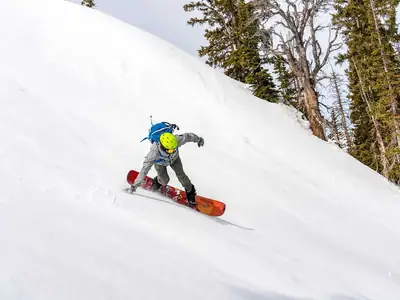
Binding-free powsurf boards pressed by hand in Logan
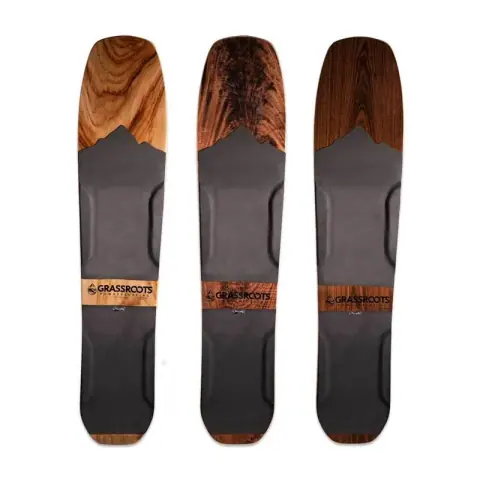
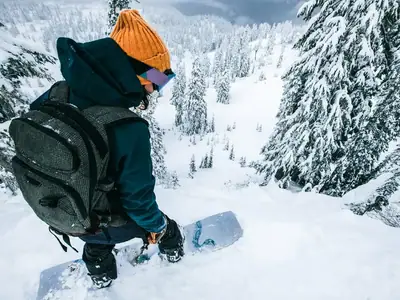
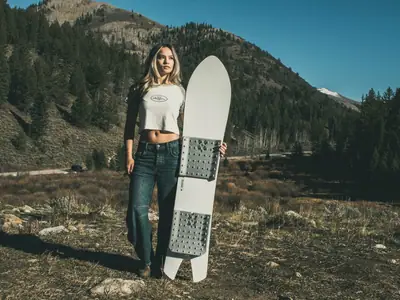
Utah State University credits Jeremy Jensen with coining the words "powdersurfing" and "powsurfing," to name a way of riding that started in the mountains of Northern Utah in 2007. The boards that needed a new word still come out of his shop in Logan. They have no bindings and no metal edges, so the only thing keeping you on top is balance.
The idea goes back to 1987, when Jensen rode a Winterstick Roundtail Plus with nothing strapping him to it, SLUG Magazine reported. Twenty years later he started pressing boards in a garage with a few friends, Brock Bitton and Craig Stevenson among them. Bitton's early board was plywood cut like a wakeboard, bent into rocker under a stack of old textbooks and cinder blocks. Few textbooks have done more useful work.
The first prototype was an old Sims snowboard cut down to size. From there the crew tried about 25 designs before settling on a handful that worked in all kinds of snow, Jensen told SLUG. A photo caption in that 2011 story called the garage a "state-of-the-art production facility." It was a garage.
The boards are still handcrafted in small batches in Logan, the company says, from hardwoods, bio-resins, Ptex and EVA foam. When The Inertia tested a Barracuda in 2017, the wood was locally sourced birch and maple. Grassroots calls its base the CDC 3-D Base, a channeled bottom it says borrows from surfboards to add float and lock in a turn.
By 2012 Snowboard Magazine found the boards selling in the US and overseas as far as Japan, with every board still built by hand. "Every air feels bigger and every line seems steeper when you're not strapped in," Jensen said. Stevenson put the business plan more simply: "It's always been about the fun."
Getting uphill came next. The company says it built the first splitsurfer in 2008, a powsurfer that splits apart to climb a skin track. Today's Grassroots Splitsurfer sells for $949.95. At the other end of the shop, a Youth Slasher sized for kids 6 to 11 costs $299.95.
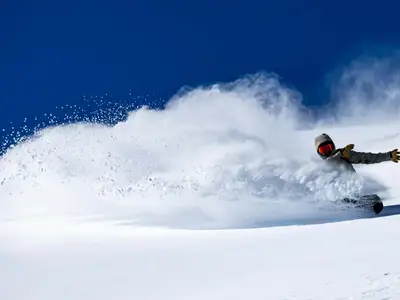
In March 2025 the professional skimboarder Blair Conklin flew in to ride with the crew. The shop's blog called the first day the deepest of the season, with three inches of snow in the parking lot and three feet at the top. They rode for about 12 hours, and by the end Conklin's favorite was the 150cm Big Phishh.
One honest warning before you buy: these boards want deep, soft snow. Joe Carberry took a lot of falls testing one for The Inertia. He says to skip hardpack, and that it gets simple once you accept that speed is your friend.
The word was coined in these mountains, and the boards that go with it are still pressed on 400 East in Logan.
Researched and written by Beehive Made. Last checked .
Work at Grassroots Powdersurfing? Confirm this page or send a fix. Get the badge for your site too.
As kids, Jensen and his friends pulled the trucks off their skateboards and rode the decks backwards down hills. SLUG Magazine reports it did not work that well.
The Monday email
What Utah brands launched this week, every Monday. Sign up and the State of Utah Brands report is yours as a thank-you.