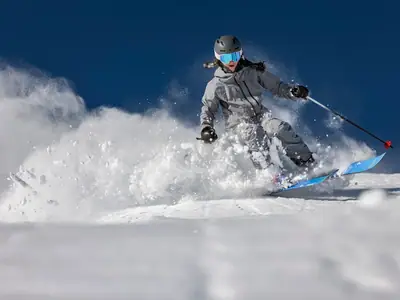
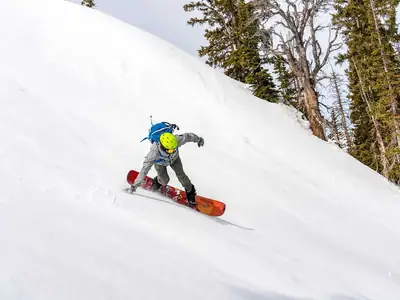
The scientist who wrote the book on Utah powder says it is not the driest snow in America. Jim Steenburgh, a University of Utah atmospheric scientist and the author of Secrets of the Greatest Snow on Earth, has said that areas in Colorado get even drier snow than Utah, according to KUTV5. Utah's snow is good for other reasons. A lot of it falls. Most storms are a useful size, and they often start warm and finish cold, so the lightest snow lands on top. It is also much drier than the coast's. Alta3 puts its average at about 8.5 percent water, against 10 to 12 percent in the Sierra Nevada.
The Great Salt Lake, which gets the credit in most bar arguments, supplies a small share of it. The companies on our ski and snow list that design around this snow mostly design for the deep days, and a couple of them build their boards and skis a short drive from the canyons.
Quick answers
Is Utah snow the driest in the U.S.?
No. A 2005 study put central Rocky Mountain stations, which include Colorado, close to 7 percent water, against about 8.5 percent for the Wasatch.
How much water is in Alta's snow?
Alta says about 8.5 percent on average. The Sierra Nevada's runs 10 to 12 percent by the same account.
Does the Great Salt Lake make Utah's snow?
Only a little. A University of Utah study found lake-effect periods supply up to 8.4 percent of cool-season precipitation in the basin, mostly in October and November.
How much snow does Alta get a year?
A University of Utah study of 2000 to 2022 found seasonal totals almost always above 300 inches and averaging more than 500. Most single storms are small, with a median of 3 inches.
Is Utah snow the driest in the country?
No, though it is a lot drier than the Sierra's. Alta's own explainer says Pacific storms lose moisture as they travel east, so by the time they reach the Wasatch the snow runs about 8.5 percent water. The rest is air.
The comparison that stings comes from a 2005 national study led by M. A. Baxter, as summarized by Utah Public Radio's Wild About Utah4. Intermountain stations, the Wasatch included, hover around 8.5 percent water. The Sierra sits around 12. Central Rocky Mountain stations averaged close to 7 percent, which means Colorado's snow is lighter on paper. Steenburgh concedes the point himself, and the summary of his book says it is "exposing the myths" of Wasatch weather lore.
Why is Utah powder so good if it isn't the driest?
Mostly volume, and the order the snow lands in. "We get lots of these what I call Goldilocks storms that are not too big. They're not too small," Steenburgh told KUER1 in 2014. "They produce the right amounts of snow for a good deep powder day. And then the storm comes stacked in the right way."
He explained the stacking to KUTV the following winter. "Most of our storms start out warm, they produce higher density snow, and then they get colder." So the denser snow goes down first and the lightest finishes on top, which is the order a skier wants.
University of Utah scientists measured how that adds up. A study the university described in February 2024, published in Monthly Weather Review, looked at 2,707 snow events at Alta from 2000 to 2022. The median event left just 3 inches, and the average was 4.4. There were 138 storms that dropped 12 inches or more, and the biggest 12-hour total was 26 inches, on March 30, 2005. Seasonal totals almost always top 300 inches and average more than 500. All of that comes without many of the moisture firehoses that feed the Sierra. "We rarely get true atmospheric river conditions at Alta," Steenburgh said. "If you go to the Sierra, most of their big snowfall events are big atmospheric river events."
How much snow comes from the Great Salt Lake?
Less than the legend. In a study of the 1998 to 2009 seasons, Steenburgh found that periods of lake-effect snow accounted for up to 8.4 percent of the total cool-season precipitation in the Great Salt Lake Basin, with the largest share falling south and east of the lake. Ski Utah8 says that zone takes in the four Cottonwood Canyon resorts, and its own estimate for the Cottonwoods is 5 to 10 percent of the snow in an average year.
The lake effect is also lumpy. It peaks in October and November, with a second, smaller bump in March and April. So the lake can help make an early season, and it rarely makes a whole one.
Most of the lake never freezes because of its salt load, according to Ski Utah, which also passes along Steenburgh's description of it as a "massive puddle" with an average depth of about 16 feet.
Which Utah ski brands are built around Wasatch snow?
The clearest case is DPS Skis. Stephan Drake and engineer Peter Turner founded it in 2005, and the company says its first notable ski, the Lotus 138, "entirely redefined powder skiing." When Drake explained to SLUG in 2017 why the company settled in Salt Lake City instead of a mountain town like Jackson, the first thing he named was "the short, triangular distance between factory/powder/airport." DPS moved to Salt Lake City in 2013 and says its headquarters and adjoining factory are "just minutes from the Wasatch Mountains."
Some companies skip the resort entirely. Voilé builds splitboards, which come apart into two skis for the climb, in a warehouse on the west side of the Salt Lake Valley. "Everything about our company is the backcountry," sales manager Dave Grissom told SLUG in 2012. Chimera Backcountry Snowboards started in 2009 in Big Cottonwood Canyon with the stated goal of being "the first splitboard-only company," and it is still based in Salt Lake City.
Armada moved its headquarters from California to Park City in 2014. Its JJ is billed as "the first all-mountain powder ski with rocker." One honest caveat applies to the list as a whole. Being designed near the snow is not the same as being made near it, and Armada carries only the Run from Utah tag in our directory, not Made in Utah. Chimera hand-builds specialty boards in Salt Lake and has a factory make its production models. The brands that do build here are on the made in Utah list, and the reasons they test close to home are in why gear brands test in Utah.
Will Utah snow stay this good?
Steenburgh's answer in 2014 was a qualified yes, as KUER reported. "I would expect that the quality would decrease some," he told KUER about a warming climate. "However, if you think about it, it's still going to be better snow than many other places." He singled out the high country above the Salt Lake Valley: "the upper Cottonwoods, they're going to be one of the places where the ski industry can continue to survive."
The lake will keep getting the credit at the bar. The skis built in Salt Lake are designed for the other nine-tenths of the snow.
Brands in this answer